Apigee X Runtime Plane vs Management Plane Explained
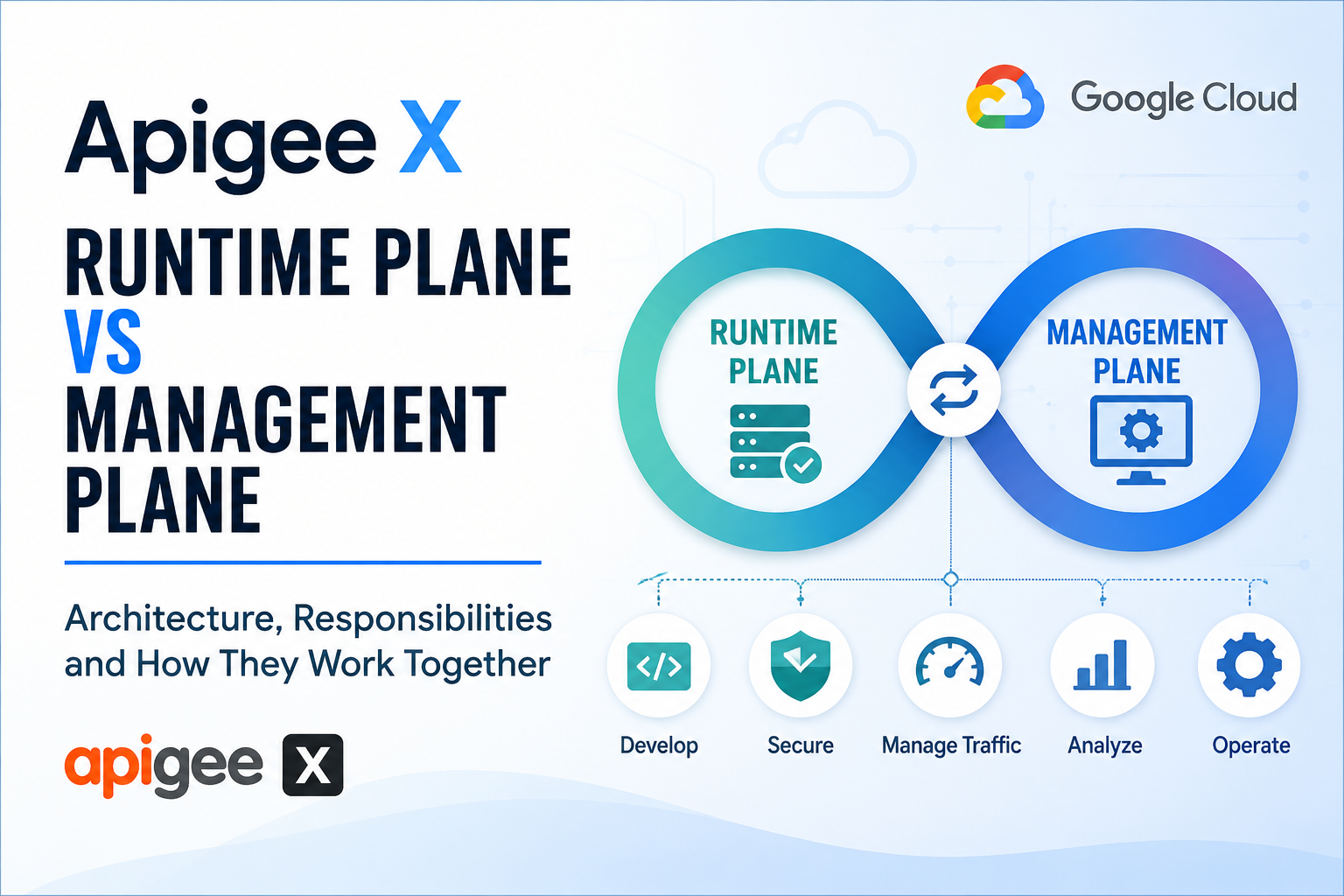
Table of Contents
When learning Google Cloud Apigee X, one of the first architectural concepts you will encounter is the distinction between the Runtime Plane and the Management Plane. Understanding the difference between these two planes is essential for designing, operating, and troubleshooting enterprise API platforms.
Although they work together as part of a single Apigee X environment, they serve very different purposes. In simple terms, the Management Plane is responsible for configuration and administration, while the Runtime Plane is responsible for processing live API traffic.
Let’s explore how these two planes work and why Google designed Apigee X this way.
Why Apigee X Uses Separate Planes
Enterprise API management platforms must support two very different workloads.
The first workload involves administrative tasks such as:
- Creating API proxies
- Managing API products
- Creating developers and applications
- Configuring security policies
- Monitoring analytics
The second workload involves processing millions of live API requests and responses.
Separating these responsibilities improves scalability, security, reliability, and operational efficiency.
This separation is one of the core architectural principles behind Apigee X.
What Is the Management Plane?
The Management Plane is responsible for all administrative and configuration-related activities within Apigee X.
It provides the tools and interfaces used by API administrators, architects, and platform engineers.
Common Management Plane responsibilities include:
- API proxy creation and deployment
- API product management
- Developer and application management
- Analytics configuration
- Environment configuration
- Security configuration
- Reporting and monitoring
When you log in to the Apigee X user interface, most of the activities you perform interact with the Management Plane.
The Management Plane stores and manages API platform configuration but does not process live API traffic.
What Is the Runtime Plane?
The Runtime Plane is the execution engine of Apigee X.
Every API request sent by consumers passes through the Runtime Plane before reaching backend services.
The Runtime Plane performs tasks such as:
- Request routing
- Policy execution
- Authentication and authorization
- Traffic management
- Message transformation
- API analytics collection
- Response processing
The Runtime Plane is responsible for delivering high-performance API processing at scale.
When an API consumer calls an API endpoint, the Runtime Plane is the component that receives, validates, processes, and forwards the request.
Understanding the Message Processor
Within the Runtime Plane, the Message Processor performs the actual execution of API proxy logic.
The Message Processor:
- Executes policies
- Applies security controls
- Performs traffic management
- Processes requests and responses
- Generates analytics events
It is often described as the “workhorse” of the Runtime Plane because it handles the majority of API processing activities.
Management Plane Workflow Example
Consider a scenario where an API architect creates a new API proxy.
The architect performs the following steps:
- Create an API proxy.
- Configure policies.
- Create API products.
- Configure developers and applications.
- Deploy the proxy to an environment.
All of these activities occur within the Management Plane.
The Management Plane then distributes the configuration to the Runtime Plane.
Runtime Plane Workflow Example
Now imagine an API consumer sends a request to the deployed API.
The Runtime Plane will:
- Receive the request.
- Validate credentials.
- Execute policies.
- Apply traffic management controls.
- Route the request to the backend service.
- Process the response.
- Return the response to the consumer.
These activities occur entirely within the Runtime Plane.
Security Benefits of Plane Separation
Separating management operations from runtime traffic provides several security advantages.
Organizations can:
- Restrict administrative access.
- Isolate runtime workloads.
- Reduce attack surfaces.
- Protect management interfaces.
- Apply different security controls to each plane.
This separation is particularly valuable in large enterprise environments where API management teams and API consumers operate independently.
High Availability and Scalability
The Runtime Plane can scale independently of the Management Plane.
For example:
- API traffic may increase dramatically during peak business periods.
- Additional runtime capacity can be added without impacting administrative services.
This design improves resilience and supports large-scale enterprise API workloads.
Common Interview Question
A frequently asked interview question is:
“What happens if the Management Plane becomes unavailable?”
The answer is that existing API traffic can continue to be processed by the Runtime Plane because deployed configurations already exist within the runtime environment.
Administrative changes may be delayed, but live APIs can continue operating.
This demonstrates the architectural separation between the two planes.
Best Practices
When working with Apigee X:
- Understand which operations belong to each plane.
- Monitor runtime performance separately from administrative activities.
- Apply least-privilege access to management functions.
- Design deployments with runtime scalability in mind.
- Use analytics to monitor runtime behavior and performance.
Conclusion
The Runtime Plane and Management Plane serve distinct but complementary roles within Apigee X. The Management Plane handles configuration, administration, analytics, and platform governance, while the Runtime Plane processes live API traffic and executes API proxy logic.
Understanding this separation is fundamental to mastering Apigee X architecture and is an essential concept for developers, architects, and API platform engineers building modern enterprise API ecosystems.
Follow Me Here